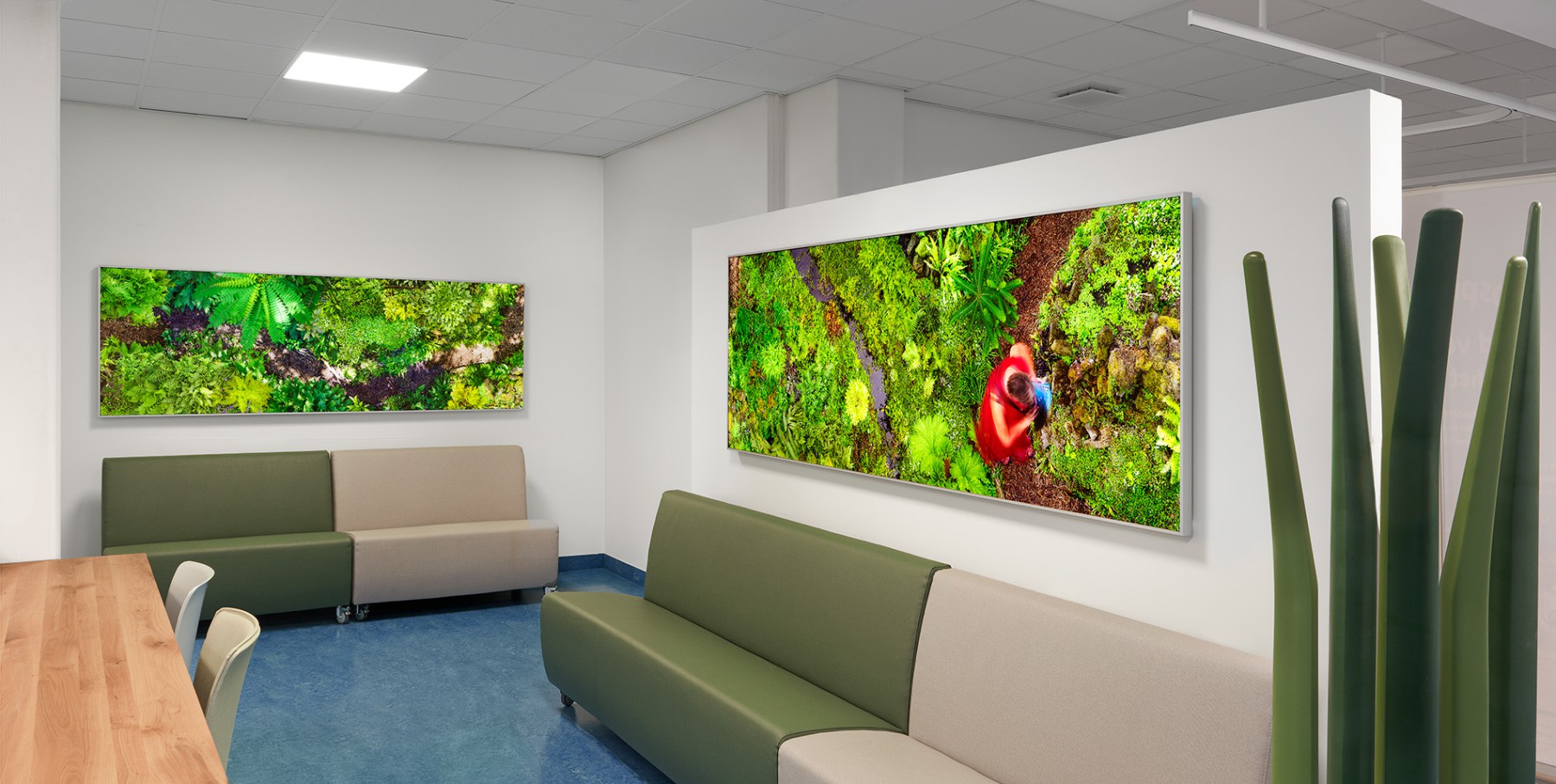
Aziatischetuin
material: Photoprint in lightbox
size: 150 x 280 cm
year: 2026
client: Leiden University Hospital, the Netherlands
Katrin Korfmann creates photographs that depict multiple moments happening simultaneously rather than focusing on a single point in time. She merges various recording times and perspectives into a single image, making her photographs more meaningful the longer you examine them. As you look, you gradually realize how time and space are interconnected within the image. Through this approach, Korfmann shows that a photograph doesn't need to freeze one moment; it can be a collage of observing, moving, and experiencing time.
For the entrance and three waiting areas of LUMC's Radiology department, she created Hortus Radiologicus: four gardens composed of nine photo collages that evoke an imaginary world within spaces where patients wait and perceive time. Her inspiration was the Hortus Botanicus Leiden, the Netherlands' oldest botanical garden, known for its centuries-long focus on research and observation. Like the LUMC, the Hortus is linked to Leiden University and functions as a place where art and science intersect, serving both as a living scientific collection and a registered museum. The garden features plants from around the globe, studied by students and researchers. Observation, collection, and interpretation—ways of viewing and understanding—are fundamental, paralleling radiological research.
Korfmann captured the four gardens from a vertical viewpoint, as if you are floating above the greenery. This perspective allows both overview and details to be seen simultaneously. The images merge thousands of moments, seasons, and lighting conditions into monumental collages where flowering and withering occur side by side. The outcome does not portray a single moment but a timeless realm of growth, change, and renewal, where knowledge and nature intertwine to create a layered visual story.
From afar, the artworks provide an overview; up close, they unveil new details such as paths, flowers, water, shadows, and figures. They encourage viewers to take their time, highlighting the gardens' ongoing movement. The works illustrate the interplay between art and science, showing how nature inspires, calms, and comforts. Research indicates that greenery can reduce stress and create a more inviting atmosphere. The lightboxes act as imaginary windows, bringing the artworks into the hospital setting, inviting visitors to look, explore, and pause.
The work goes beyond mere presence. It fosters an environment of calm, wonder, and attentiveness. By blending micro- and macrocosmic elements, the waiting area is given a more human scale. Her art turns waiting rooms into spaces filled with beauty, vitality, and imagination — offering a connection to nature, time, and us, all within the hospital's core.
Many thanks to Leiden University Hospital Art Committee, Sandrine van Noort, and Mondriaan Funds, the Netherlands.
Text by Christine van den Bergh. Photo documentation by Gert Jan van Rooij.
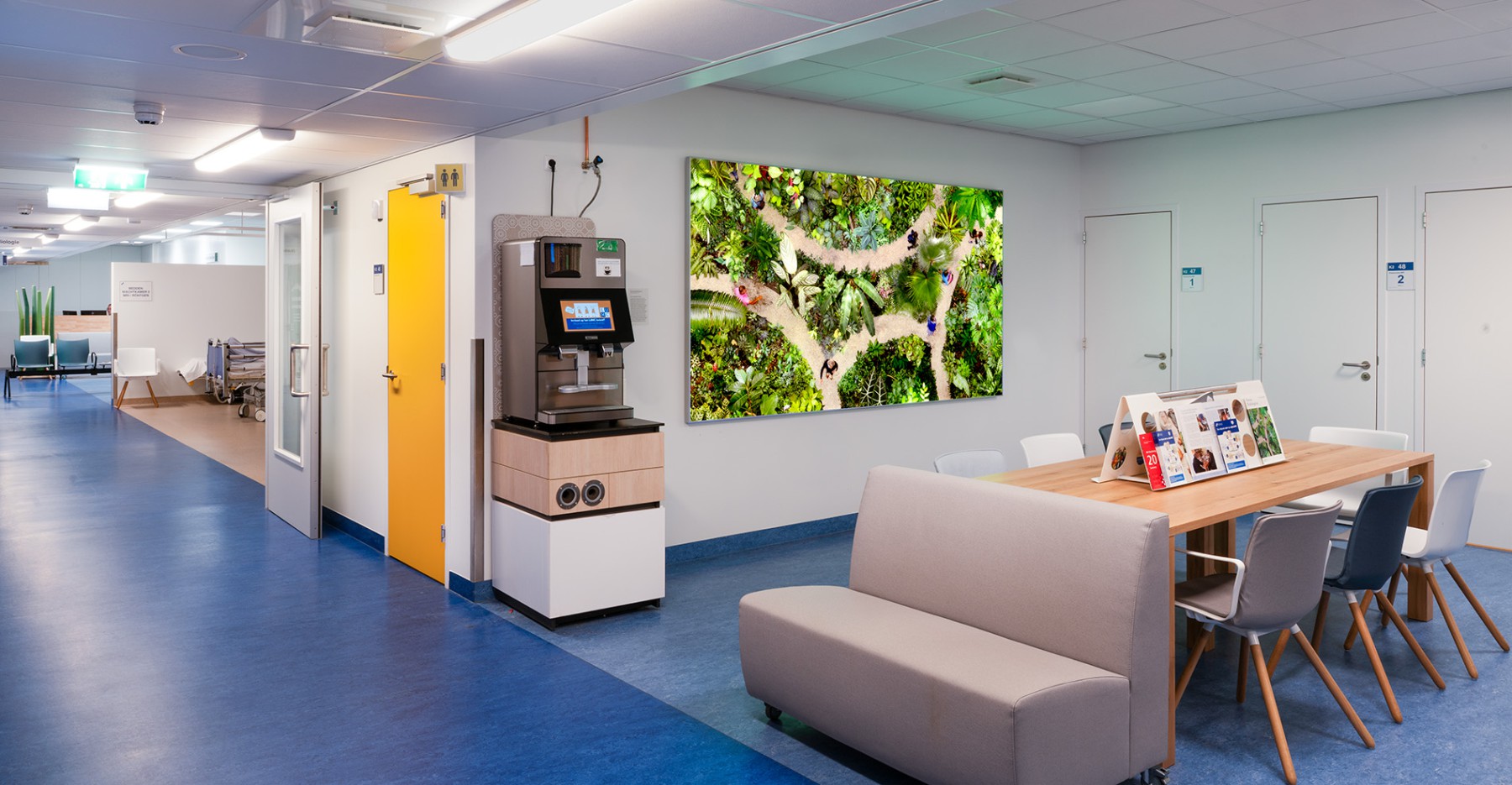
Aziatischetuin
material: Photoprint in lightbox
size: 80 x 235 cm
year: 2026
client: Leiden University Hospital, the Netherlands
Katrin Korfmann creates photographs that depict multiple moments happening simultaneously rather than focusing on a single point in time. She merges various recording times and perspectives into a single image, making her photographs more meaningful the longer you examine them. As you look, you gradually realize how time and space are interconnected within the image. Through this approach, Korfmann shows that a photograph doesn't need to freeze one moment; it can be a collage of observing, moving, and experiencing time.
For the entrance and three waiting areas of LUMC's Radiology department, she created Hortus Radiologicus: four gardens composed of nine photo collages that evoke an imaginary world within spaces where patients wait and perceive time. Her inspiration was the Hortus Botanicus Leiden, the Netherlands' oldest botanical garden, known for its centuries-long focus on research and observation. Like the LUMC, the Hortus is linked to Leiden University and functions as a place where art and science intersect, serving both as a living scientific collection and a registered museum. The garden features plants from around the globe, studied by students and researchers. Observation, collection, and interpretation—ways of viewing and understanding—are fundamental, paralleling radiological research.
Korfmann captured the four gardens from a vertical viewpoint, as if you are floating above the greenery. This perspective allows both overview and details to be seen simultaneously. The images merge thousands of moments, seasons, and lighting conditions into monumental collages where flowering and withering occur side by side. The outcome does not portray a single moment but a timeless realm of growth, change, and renewal, where knowledge and nature intertwine to create a layered visual story.
From afar, the artworks provide an overview; up close, they unveil new details such as paths, flowers, water, shadows, and figures. They encourage viewers to take their time, highlighting the gardens' ongoing movement. The works illustrate the interplay between art and science, showing how nature inspires, calms, and comforts. Research indicates that greenery can reduce stress and create a more inviting atmosphere. The lightboxes act as imaginary windows, bringing the artworks into the hospital setting, inviting visitors to look, explore, and pause.
The work goes beyond mere presence. It fosters an environment of calm, wonder, and attentiveness. By blending micro- and macrocosmic elements, the waiting area is given a more human scale. Her art turns waiting rooms into spaces filled with beauty, vitality, and imagination — offering a connection to nature, time, and us, all within the hospital's core.
Many thanks to Leiden University Hospital Art Committee, Sandrine van Noort, and Mondriaan Funds, the Netherlands.
Text by Christine van den Bergh. Photo documentation by Gert Jan van Rooij.
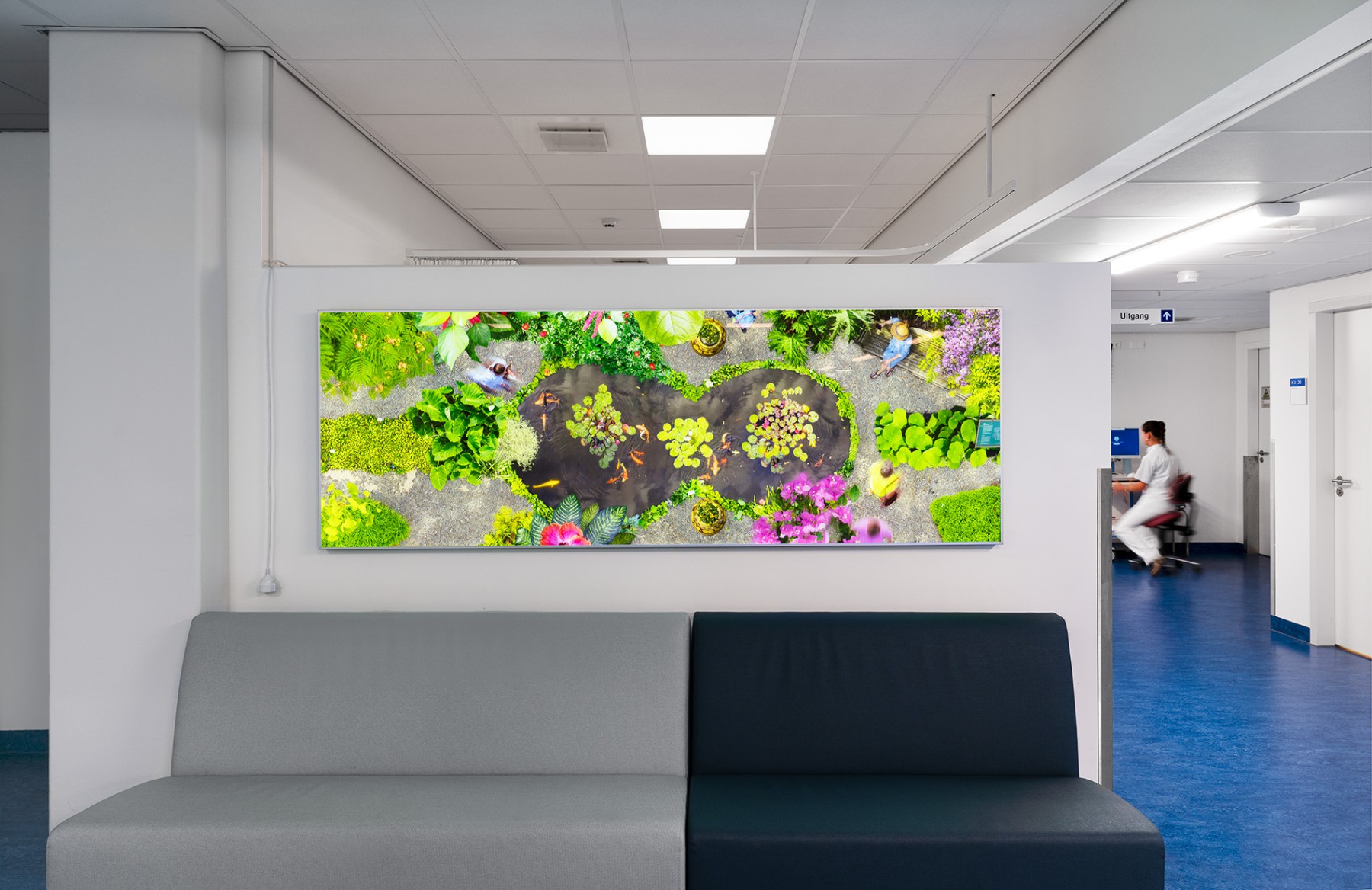
Clusiustuin
material: Photoprint in lightbox
size: Triptych, Each panel measures 190 x 120 cm
year: 2026
client: Leiden University Hospital, the Netherlands
Katrin Korfmann creates photographs that depict multiple moments happening simultaneously rather than focusing on a single point in time. She merges various recording times and perspectives into a single image, making her photographs more meaningful the longer you examine them. As you look, you gradually realize how time and space are interconnected within the image. Through this approach, Korfmann shows that a photograph doesn't need to freeze one moment; it can be a collage of observing, moving, and experiencing time.
For the entrance and three waiting areas of LUMC's Radiology department, she created Hortus Radiologicus: four gardens composed of nine photo collages that evoke an imaginary world within spaces where patients wait and perceive time. Her inspiration was the Hortus Botanicus Leiden, the Netherlands' oldest botanical garden, known for its centuries-long focus on research and observation. Like the LUMC, the Hortus is linked to Leiden University and functions as a place where art and science intersect, serving both as a living scientific collection and a registered museum. The garden features plants from around the globe, studied by students and researchers. Observation, collection, and interpretation—ways of viewing and understanding—are fundamental, paralleling radiological research.
Korfmann captured the four gardens from a vertical viewpoint, as if you are floating above the greenery. This perspective allows both overview and details to be seen simultaneously. The images merge thousands of moments, seasons, and lighting conditions into monumental collages where flowering and withering occur side by side. The outcome does not portray a single moment but a timeless realm of growth, change, and renewal, where knowledge and nature intertwine to create a layered visual story.
From afar, the artworks provide an overview; up close, they unveil new details such as paths, flowers, water, shadows, and figures. They encourage viewers to take their time, highlighting the gardens' ongoing movement. The works illustrate the interplay between art and science, showing how nature inspires, calms, and comforts. Research indicates that greenery can reduce stress and create a more inviting atmosphere. The lightboxes act as imaginary windows, bringing the artworks into the hospital setting, inviting visitors to look, explore, and pause.
The work goes beyond mere presence. It fosters an environment of calm, wonder, and attentiveness. By blending micro- and macrocosmic elements, the waiting area is given a more human scale. Her art turns waiting rooms into spaces filled with beauty, vitality, and imagination — offering a connection to nature, time, and us, all within the hospital's core.
Many thanks to Leiden University Hospital Art Committee, Sandrine van Noort, and Mondriaan Funds, the Netherlands.
Text by Christine van den Bergh. Photo documentation by Gert Jan van Rooij.
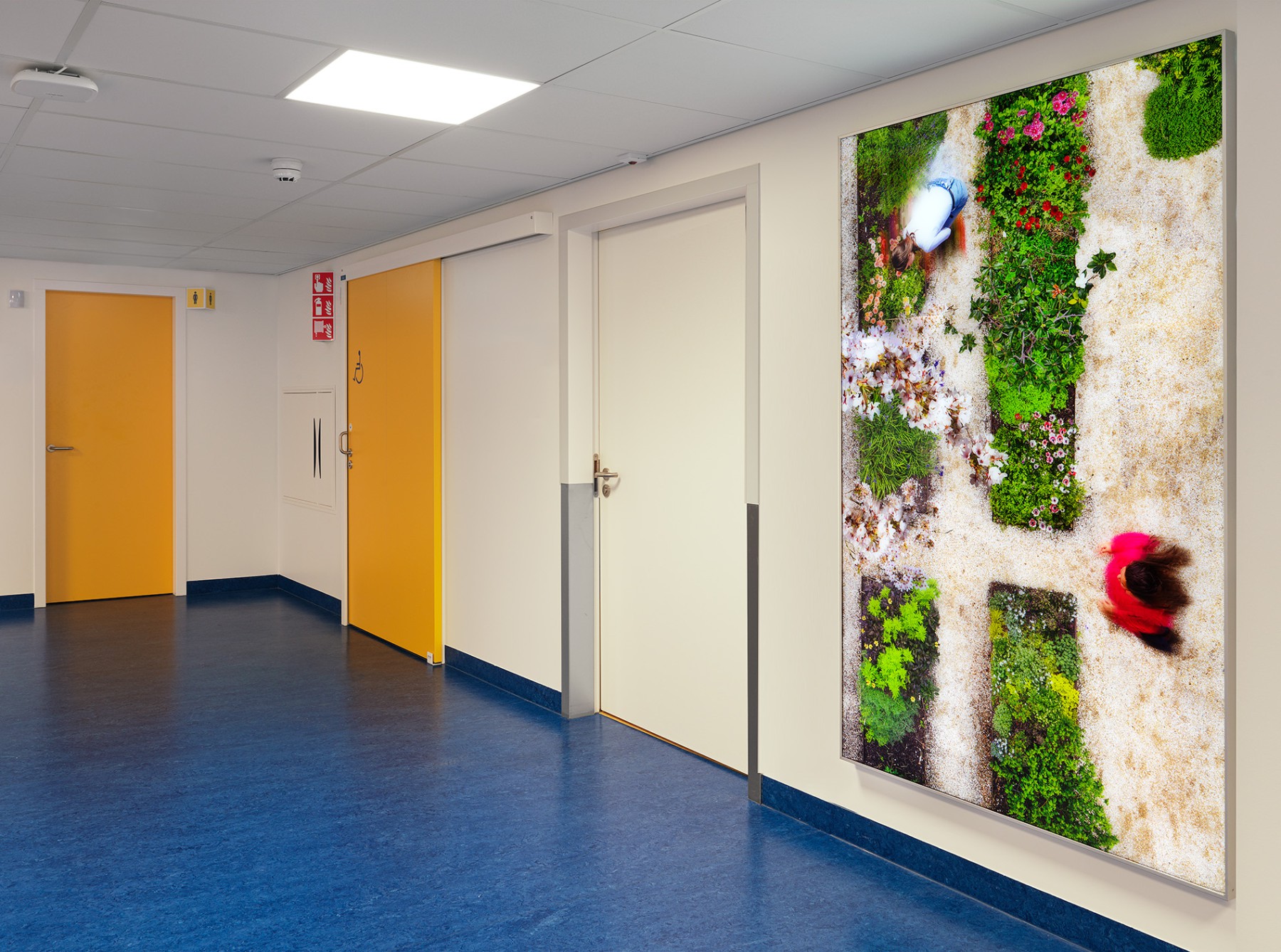
Clusiustuin
material: Photoprint in lightbox
size: Triptych, Each panel measures 190 x 120 cm
year: 2026
client: Leiden University Hospital, the Netherlands
Katrin Korfmann creates photographs that depict multiple moments happening simultaneously rather than focusing on a single point in time. She merges various recording times and perspectives into a single image, making her photographs more meaningful the longer you examine them. As you look, you gradually realize how time and space are interconnected within the image. Through this approach, Korfmann shows that a photograph doesn't need to freeze one moment; it can be a collage of observing, moving, and experiencing time.
For the entrance and three waiting areas of LUMC's Radiology department, she created Hortus Radiologicus: four gardens composed of nine photo collages that evoke an imaginary world within spaces where patients wait and perceive time. Her inspiration was the Hortus Botanicus Leiden, the Netherlands' oldest botanical garden, known for its centuries-long focus on research and observation. Like the LUMC, the Hortus is linked to Leiden University and functions as a place where art and science intersect, serving both as a living scientific collection and a registered museum. The garden features plants from around the globe, studied by students and researchers. Observation, collection, and interpretation—ways of viewing and understanding—are fundamental, paralleling radiological research.
Korfmann captured the four gardens from a vertical viewpoint, as if you are floating above the greenery. This perspective allows both overview and details to be seen simultaneously. The images merge thousands of moments, seasons, and lighting conditions into monumental collages where flowering and withering occur side by side. The outcome does not portray a single moment but a timeless realm of growth, change, and renewal, where knowledge and nature intertwine to create a layered visual story.
From afar, the artworks provide an overview; up close, they unveil new details such as paths, flowers, water, shadows, and figures. They encourage viewers to take their time, highlighting the gardens' ongoing movement. The works illustrate the interplay between art and science, showing how nature inspires, calms, and comforts. Research indicates that greenery can reduce stress and create a more inviting atmosphere. The lightboxes act as imaginary windows, bringing the artworks into the hospital setting, inviting visitors to look, explore, and pause.
The work goes beyond mere presence. It fosters an environment of calm, wonder, and attentiveness. By blending micro- and macrocosmic elements, the waiting area is given a more human scale. Her art turns waiting rooms into spaces filled with beauty, vitality, and imagination — offering a connection to nature, time, and us, all within the hospital's core.
Many thanks to Leiden University Hospital Art Committee, Sandrine van Noort, and Mondriaan Funds, the Netherlands.
Text by Christine van den Bergh. Photo documentation by Gert Jan van Rooij.
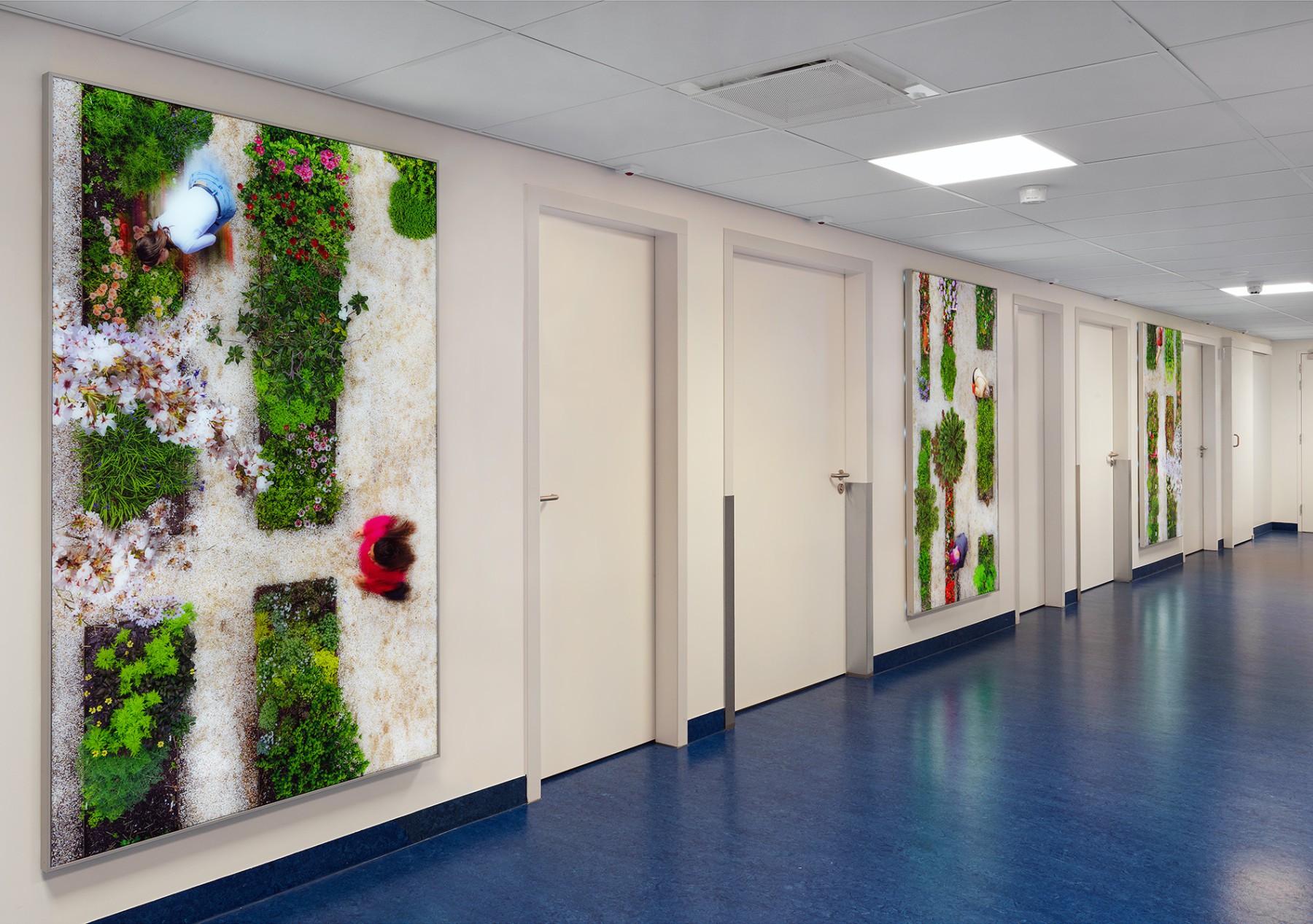
Rozentuin
material: Photoprint in lightbox
size: 140 x 350 cm
year: 2026
client: Leiden University Hospital, the Netherlands
Katrin Korfmann creates photographs that depict multiple moments happening simultaneously rather than focusing on a single point in time. She merges various recording times and perspectives into a single image, making her photographs more meaningful the longer you examine them. As you look, you gradually realize how time and space are interconnected within the image. Through this approach, Korfmann shows that a photograph doesn't need to freeze one moment; it can be a collage of observing, moving, and experiencing time.
For the entrance and three waiting areas of LUMC's Radiology department, she created Hortus Radiologicus: four gardens composed of nine photo collages that evoke an imaginary world within spaces where patients wait and perceive time. Her inspiration was the Hortus Botanicus Leiden, the Netherlands' oldest botanical garden, known for its centuries-long focus on research and observation. Like the LUMC, the Hortus is linked to Leiden University and functions as a place where art and science intersect, serving both as a living scientific collection and a registered museum. The garden features plants from around the globe, studied by students and researchers. Observation, collection, and interpretation—ways of viewing and understanding—are fundamental, paralleling radiological research.
Korfmann captured the four gardens from a vertical viewpoint, as if you are floating above the greenery. This perspective allows both overview and details to be seen simultaneously. The images merge thousands of moments, seasons, and lighting conditions into monumental collages where flowering and withering occur side by side. The outcome does not portray a single moment but a timeless realm of growth, change, and renewal, where knowledge and nature intertwine to create a layered visual story.
From afar, the artworks provide an overview; up close, they unveil new details such as paths, flowers, water, shadows, and figures. They encourage viewers to take their time, highlighting the gardens' ongoing movement. The works illustrate the interplay between art and science, showing how nature inspires, calms, and comforts. Research indicates that greenery can reduce stress and create a more inviting atmosphere. The lightboxes act as imaginary windows, bringing the artworks into the hospital setting, inviting visitors to look, explore, and pause.
The work goes beyond mere presence. It fosters an environment of calm, wonder, and attentiveness. By blending micro- and macrocosmic elements, the waiting area is given a more human scale. Her art turns waiting rooms into spaces filled with beauty, vitality, and imagination — offering a connection to nature, time, and us, all within the hospital's core.
Many thanks to Leiden University Hospital Art Committee, Sandrine van Noort, and Mondriaan Funds, the Netherlands.
Text by Christine van den Bergh. Photo documentation by Gert Jan van Rooij.
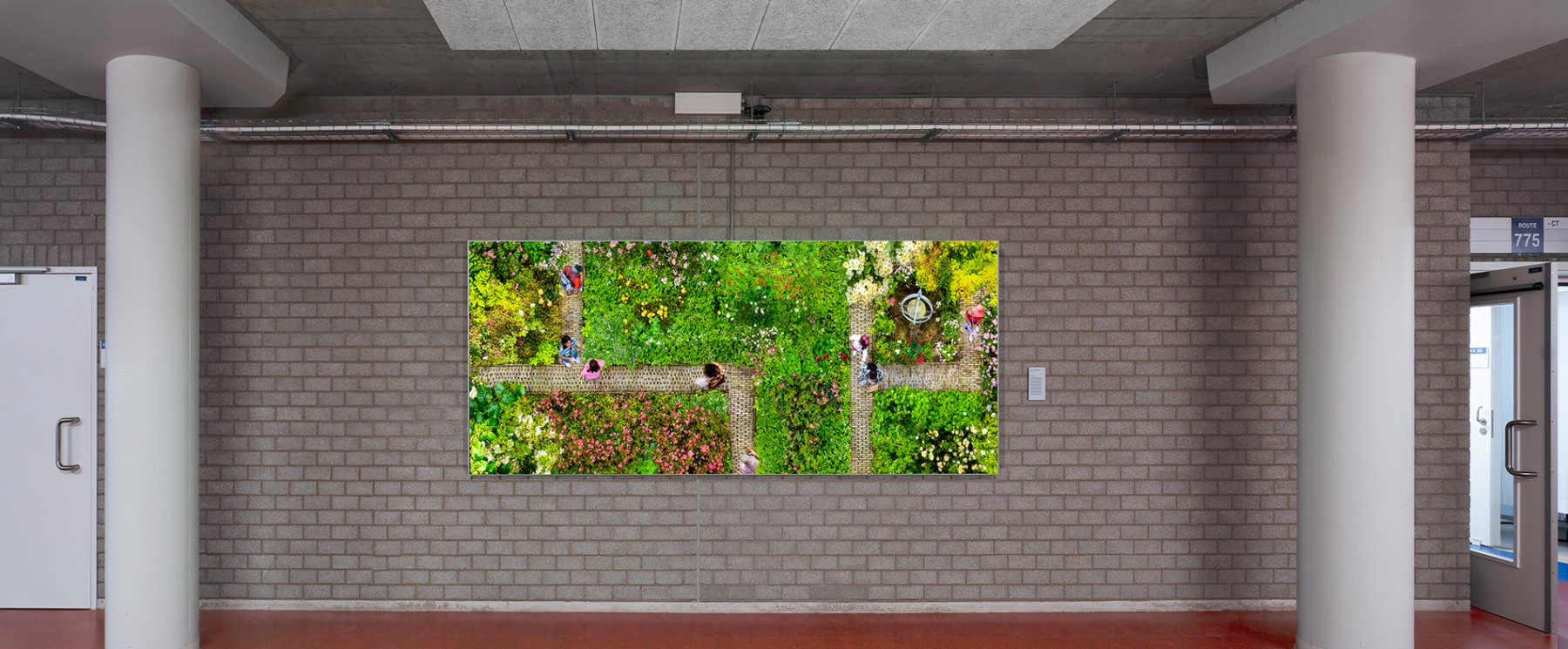
Varentuin
material: Photoprint in lightbox
size: Triptych, Each panel measures 80 x 250 cm
year: 2026
client: Leiden University Hospital, the Netherlands
Katrin Korfmann creates photographs that depict multiple moments happening simultaneously rather than focusing on a single point in time. She merges various recording times and perspectives into a single image, making her photographs more meaningful the longer you examine them. As you look, you gradually realize how time and space are interconnected within the image. Through this approach, Korfmann shows that a photograph doesn't need to freeze one moment; it can be a collage of observing, moving, and experiencing time.
For the entrance and three waiting areas of LUMC's Radiology department, she created Hortus Radiologicus: four gardens composed of nine photo collages that evoke an imaginary world within spaces where patients wait and perceive time. Her inspiration was the Hortus Botanicus Leiden, the Netherlands' oldest botanical garden, known for its centuries-long focus on research and observation. Like the LUMC, the Hortus is linked to Leiden University and functions as a place where art and science intersect, serving both as a living scientific collection and a registered museum. The garden features plants from around the globe, studied by students and researchers. Observation, collection, and interpretation—ways of viewing and understanding—are fundamental, paralleling radiological research.
Korfmann captured the four gardens from a vertical viewpoint, as if you are floating above the greenery. This perspective allows both overview and details to be seen simultaneously. The images merge thousands of moments, seasons, and lighting conditions into monumental collages where flowering and withering occur side by side. The outcome does not portray a single moment but a timeless realm of growth, change, and renewal, where knowledge and nature intertwine to create a layered visual story.
From afar, the artworks provide an overview; up close, they unveil new details such as paths, flowers, water, shadows, and figures. They encourage viewers to take their time, highlighting the gardens' ongoing movement. The works illustrate the interplay between art and science, showing how nature inspires, calms, and comforts. Research indicates that greenery can reduce stress and create a more inviting atmosphere. The lightboxes act as imaginary windows, bringing the artworks into the hospital setting, inviting visitors to look, explore, and pause.
The work goes beyond mere presence. It fosters an environment of calm, wonder, and attentiveness. By blending micro- and macrocosmic elements, the waiting area is given a more human scale. Her art turns waiting rooms into spaces filled with beauty, vitality, and imagination — offering a connection to nature, time, and us, all within the hospital's core.
Many thanks to Leiden University Hospital Art Committee, Sandrine van Noort, and Mondriaan Funds, the Netherlands.
Text by Christine van den Bergh. Photo documentation by Gert Jan van Rooij.
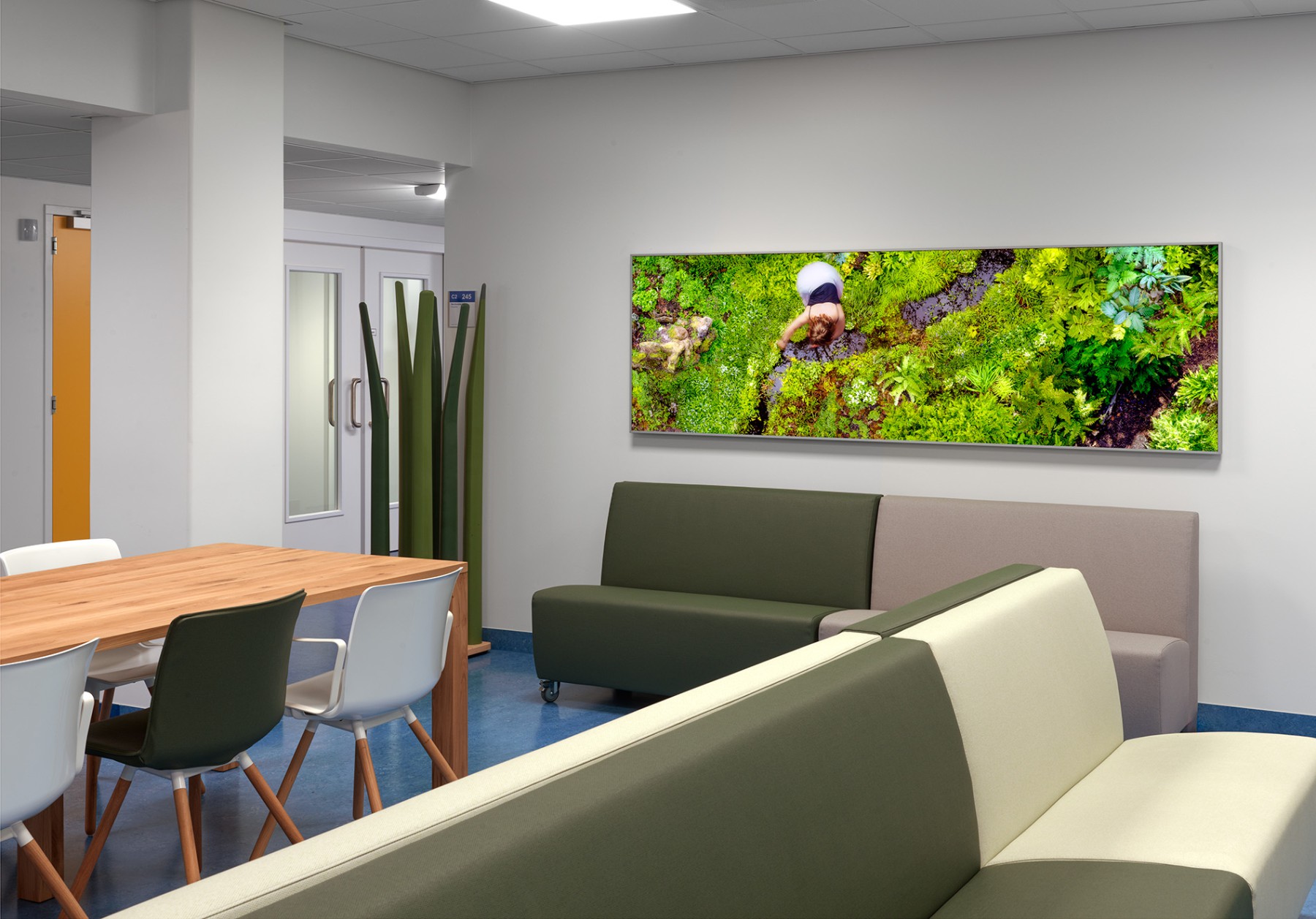
Varentuin
material: Photoprint in lightbox
size: Triptych, Each panel measures 80 x 250 cm
year: 2026
client: Leiden University Hospital, the Netherlands
Katrin Korfmann creates photographs that depict multiple moments happening simultaneously rather than focusing on a single point in time. She merges various recording times and perspectives into a single image, making her photographs more meaningful the longer you examine them. As you look, you gradually realize how time and space are interconnected within the image. Through this approach, Korfmann shows that a photograph doesn't need to freeze one moment; it can be a collage of observing, moving, and experiencing time.
For the entrance and three waiting areas of LUMC's Radiology department, she created Hortus Radiologicus: four gardens composed of nine photo collages that evoke an imaginary world within spaces where patients wait and perceive time. Her inspiration was the Hortus Botanicus Leiden, the Netherlands' oldest botanical garden, known for its centuries-long focus on research and observation. Like the LUMC, the Hortus is linked to Leiden University and functions as a place where art and science intersect, serving both as a living scientific collection and a registered museum. The garden features plants from around the globe, studied by students and researchers. Observation, collection, and interpretation—ways of viewing and understanding—are fundamental, paralleling radiological research.
Korfmann captured the four gardens from a vertical viewpoint, as if you are floating above the greenery. This perspective allows both overview and details to be seen simultaneously. The images merge thousands of moments, seasons, and lighting conditions into monumental collages where flowering and withering occur side by side. The outcome does not portray a single moment but a timeless realm of growth, change, and renewal, where knowledge and nature intertwine to create a layered visual story.
From afar, the artworks provide an overview; up close, they unveil new details such as paths, flowers, water, shadows, and figures. They encourage viewers to take their time, highlighting the gardens' ongoing movement. The works illustrate the interplay between art and science, showing how nature inspires, calms, and comforts. Research indicates that greenery can reduce stress and create a more inviting atmosphere. The lightboxes act as imaginary windows, bringing the artworks into the hospital setting, inviting visitors to look, explore, and pause.
The work goes beyond mere presence. It fosters an environment of calm, wonder, and attentiveness. By blending micro- and macrocosmic elements, the waiting area is given a more human scale. Her art turns waiting rooms into spaces filled with beauty, vitality, and imagination — offering a connection to nature, time, and us, all within the hospital's core.
Many thanks to Leiden University Hospital Art Committee, Sandrine van Noort, and Mondriaan Funds, the Netherlands.
Text by Christine van den Bergh. Photo documentation by Gert Jan van Rooij.